FX-Port vs. the Typical Flight API: Built for Travel Agencies, Not Just Developers
Most teams judge a flight API by its docs and a test call. The real differences show up six months in: access, fees, coverage and currencies. Here is what to check before you integrate, and how FX-Port compares.

On this page
- Five things to check before you pick a flight API
- Complex before you have written a line of code
- The fee schedule you do not see until you are already committed
- Strong in one region, thin everywhere else
- Priced as if the provider had only one headquarters
- More content without re-integrating
- When a narrower API is genuinely fine
- Frequently asked questions
- Do I need a contract to use the FX-Port flight API?
- What sources does FX-Port search?
- Is there an extra fee per API call?
- Which currencies are supported?
- Where do I start?
- Start building
Most teams evaluate a flight API the way they would evaluate any other API: read the docs, run a test call, check the response shape. That tells you almost nothing about what it is actually like to run a travel business on top of it.
The real test shows up later. It is the certification process that appears after the demo call. The fee line you did not notice on the pricing page. The country your biggest customer flies to that the API barely covers. The invoice that only makes sense if your business settles in dollars.
None of that shows up in a sandbox. All of it shows up six months in.
Five things to check before you pick a flight API#
| Question | What to look for | How FX-Port answers it |
|---|---|---|
| How hard is access? | Certification calls, technical review, a contract before a production key | Create an account, generate a key: no approval queue, no agreement, no deposit |
| What are the fees really? | Platform fees, minimum monthly commitments, per-call charges | One visible formula; no API fee on top, no minimum commitment |
| How deep is the coverage? | Content outside the region the API was built for (the Gulf, North Africa and beyond) | GDS, NDC, low-cost carrier and direct airline sources in a single call, and growing |
| Can you settle in your currency? | USD- or EUR-only settlement, wire-only funding, credit checks | A multi-currency agency balance, exchange rate in the pricing response, crypto funding |
| Does more content mean a rebuild? | Separate integrations per source, breaking changes | New suppliers appear in the same response; breaking changes ship as a new API version |
Complex before you have written a line of code#
A lot of flight distribution APIs, especially the legacy GDS-style ones, treat access as something you earn. Certification calls. Technical review. A commercial agreement to sign before you get a production key. Weeks, sometimes months, between "we are interested" and "we can actually book a ticket".
That process exists for real reasons in a huge, mature industry. It is also completely disconnected from how a modern travel business wants to move.
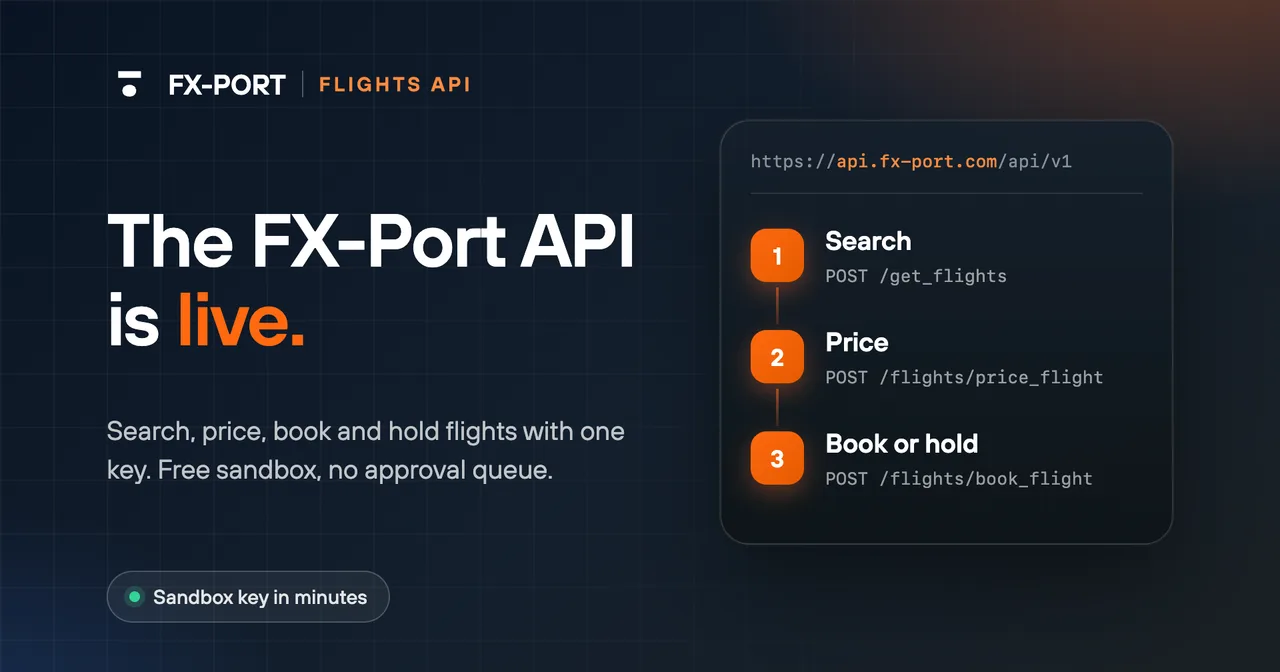
FX-Port skips it. No approval queue, no agreement to sign, no deposit. Create an account, generate a key, and your first search call works immediately. The sandbox is free, so you can build the entire integration before you fund a single dollar of live balance. The quickstart takes about ten minutes.
The fee schedule you do not see until you are already committed#
Ask around and you will hear the same story from a lot of agencies: the per-ticket economics looked fine on the sales call, and then the platform fee showed up. Or the minimum monthly commitment. Or a per-call charge stacked on top of the fare itself, so every search, successful booking or not, has a cost attached.
None of that is disclosed maliciously. It is just how a lot of these commercial models are built, and it is easy to miss until you are already integrated and the first invoice lands.
FX-Port's pricing is a single, visible formula: base fare plus taxes and fees plus your own commission equals what the traveler pays. What actually debits your balance is that total minus your commission. You set the markup. There is no separate API fee layered underneath it and no minimum commitment to hit before the economics make sense. Every field is explained in the flight pricing guide.
Strong in one region, thin everywhere else#
A lot of flight APIs are genuinely excellent in the market they were built for: deep content in North America or Europe, then noticeably thinner once you are searching routes through the Gulf, North Africa or other markets that were not the original design target. That is not a flaw exactly. It is what happens when an API is built around one region's GDS relationships and expanded outward later.
For a B2B travel business serving customers who do not all fly the same handful of transatlantic routes, that gap is the whole ballgame.
FX-Port searches across GDS, NDC, low-cost carrier and direct airline sources in a single call, and the supplier network keeps expanding behind the scenes (more connections, more coverage) without your integration having to change. Any change big enough to break a request ships under a new API version instead, so broader coverage does not come at the cost of a rebuild.
Priced as if the provider had only one headquarters#
This one is easy to underestimate until you are the agency it happens to: an API that settles exclusively in USD or EUR, funded by wire transfer, sometimes gated behind a credit check or a minimum deposit before you can go live. For a business operating in a market where none of that lines up cleanly with how money actually moves, it is friction stacked on top of friction.
FX-Port is built around an agency balance that supports multiple currencies, with an exchange rate returned directly in the pricing response whenever a supplier prices in something other than your settlement currency: no separate lookup, no guessing. Funding that balance is not limited to a single rail either; agencies in markets where card and wire access is slow or expensive can fund it in crypto.
More content without re-integrating#
"More content" sounds like a vague sales pitch until you translate it into what it means for an agency: fewer "we do not have that fare" moments. One search returning the best available price across every connected source, instead of a developer manually querying three different APIs and merging the results.
That is the entire premise of a unified travel API. It is also the part that is hardest to bolt on after the fact, which is exactly why it is worth checking before you integrate, not after.
When a narrower API is genuinely fine#
To be fair: if you are building something that only ever needs one specific market or one narrow use case (a single-route booking widget for a single destination, say), a narrower, single-source API might be all you need, and simpler for it.
That is a smaller set of businesses than the pitch decks suggest. Most travel agencies, OTAs and wholesalers do not stay narrow on purpose. They grow into new markets, new currencies and new customer bases, and the API either grows with them or becomes the next thing they have to migrate off.
Frequently asked questions#
Do I need a contract to use the FX-Port flight API?#
No. There is no approval queue, no agreement to sign and no deposit: you create an account, generate a key and your first call works immediately. A live key works against a funded balance.
What sources does FX-Port search?#
GDS, NDC, low-cost carrier and direct airline sources, in a single call. The suppliers your key can reach are listed in the suppliers guide.
Is there an extra fee per API call?#
No. FX-Port's pricing is one formula (base fare plus taxes and fees plus your commission). There is no separate API fee on top and no minimum commitment.
Which currencies are supported?#
The agency balance supports multiple currencies, and the pricing response includes the exchange rate whenever a supplier prices in a different currency from your settlement currency. Funding is not limited to cards and wires: crypto is supported too.
Where do I start?#
Read the quickstart, grab a sandbox key from your dashboard and run a search. If you want the full picture first, the API documentation covers flights, hotels and eSIMs.
Start building#
- API documentation: guides, reference and runnable samples
- API keys: generate a sandbox key from your dashboard
- Flights API overview: what the platform offers agencies