FX-Port vs. Airalo and Holafly: The eSIM Choice for Travel Agencies, Not Just Travelers
Airalo and Holafly are built for travelers. A travel agency needs infrastructure for every trip it sells. Here is how the FX-Port eSIM API compares on integration, pricing, coverage, funding and customer ownership.
On this page
- FX-Port vs. a consumer eSIM brand's partner program at a glance
- Both are excellent at what they were built for
- Where the eSIM lives in your business
- Rates built for resale, not for referrals
- Coverage that is not tied to one brand's network
- Funding that matches how agencies actually pay
- The customer stays yours
- When Airalo or Holafly is genuinely the better call
- Frequently asked questions
- Can a travel agency resell Airalo or Holafly eSIMs?
- Is FX-Port's eSIM product a consumer app?
- How do I add eSIMs to my own booking flow?
- Which currencies can I fund my balance in?
- Start building
If a traveler asks the internet "best eSIM for my trip", Airalo and Holafly are probably the first two names that come back. That is fair. Both built large, well-run consumer eSIM brands, with millions of users between them and apps that make buying a data plan for one trip almost effortless.
That is exactly the point, and exactly why they are the wrong comparison for a travel agency to be making.
A traveler needs a data plan for one trip. A travel agency needs infrastructure for every trip it sells, this year and next. Those are different problems, and they call for different platforms.
FX-Port vs. a consumer eSIM brand's partner program at a glance#
| A consumer eSIM brand's partner program | FX-Port | |
|---|---|---|
| Built around | A consumer app that acquires individual travelers; the partner layer extends the brand outward | A B2B travel platform for agencies, OTAs and wholesalers |
| Where the eSIM lives | Its own login, dashboard, payment relationship and support queue | The same account, balance and API as flights and hotels |
| Pricing | Typically a commission on the retail price, or a discount off it | Wholesale net rates plus your own commission: you set the margin |
| Coverage | One brand's inventory, coverage map and outages | Sourced across several supplier networks behind one API |
| Funding | Built around an individual traveler paying by card for one plan | One agency balance, funded in several currencies, including crypto |
| The customer | An eSIM brand's customer wearing your colors | Your booking flow, your confirmation email, your brand |
Both are excellent at what they were built for#
Worth saying plainly: Airalo and Holafly are not weak products. Both have since layered partner programs, reseller dashboards and APIs on top of their consumer apps, and both make it genuinely easy for a business to start referring or reselling eSIMs.
But the core of each business is still a consumer app, built to acquire individual travelers directly. The partner layer sits on top of that: a way to extend a consumer brand outward, not a platform designed around how a travel agency actually operates. That distinction matters more than it sounds like it should.
Where the eSIM lives in your business#
Sell through a consumer eSIM brand's partner program and connectivity becomes its own line item: its own login, its own dashboard, its own payment relationship and its own support queue, sitting next to, but separate from, everything else you sell.
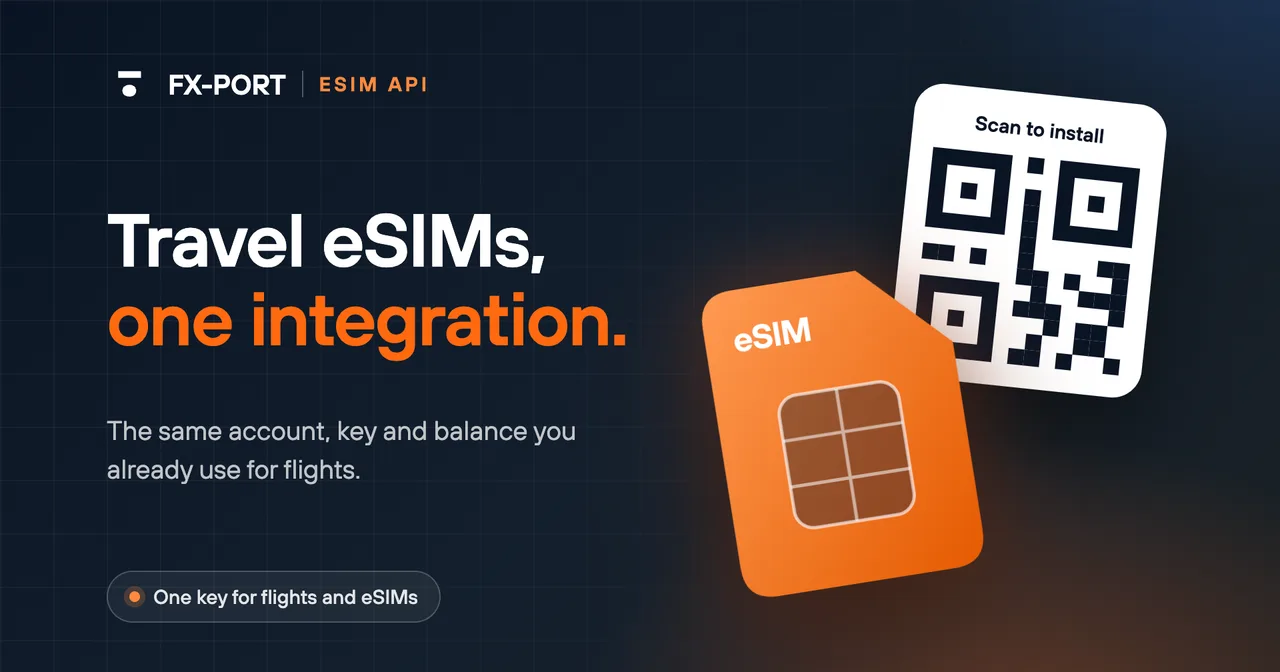
On FX-Port it is not separate. The eSIM sits in the same account, the same balance and the same API as flights and hotels. One login for the agency. One integration for the developer. One place where a flight, a hotel reservation and an eSIM order all show up together, because they are usually the same trip.
If your business is built around travel, and not around connectivity as a category, that is the difference that shows up in your workflow six months in. The eSIM API guide shows how little there is to integrate.
Rates built for resale, not for referrals#
Consumer partner programs are typically built around a commission on the retail price, or a discount off it. That works fine for an affiliate publishing a blog post or a creator with an audience.
It works less well for a travel agency that wants to set its own margin, bundle connectivity into a package price, or quote a corporate client a single number that includes the flight, the hotel and the data plan.
FX-Port prices eSIMs the way it prices everything else on the platform: wholesale, net rates with your own commission on top. Every package shows its base price, the retail price and exactly what is debited from your balance (how eSIM pricing works). You decide the margin. You decide whether it shows up as a line item or gets folded into a package. Nobody's fixed commission structure decides that for you.
Coverage that is not tied to one brand's network#
Because FX-Port's eSIM catalog is sourced across several supplier networks behind a single API, coverage and reliability in any given destination do not depend on one company's carrier relationships. If one network has a gap or an outage in a country, the platform is not limited to that single path, the same way flight search on FX-Port is not limited to a single airline or reservation system.
A single-brand consumer platform, by contrast, is exactly that: one brand's inventory, one brand's coverage map, one brand's outages.
Funding that matches how agencies actually pay#
An individual traveler is fine entering a card number for a single $12 eSIM. A travel agency is funding dozens of bookings a week, often across borders, often in a currency that does not match wherever the eSIM company happens to be headquartered.
FX-Port's agency balance supports funding in multiple currencies, including crypto, which matters more than it might sound for agencies operating in markets where card rails are slow, expensive or simply unavailable for B2B volume. It is one balance funding every product on the platform, not a separate payment method to set up per supplier.
The customer stays yours#
This is the one that is easy to underweight and expensive to get wrong.
Route a customer through an affiliate link or a co-branded partner page and, at some level, they are a customer of the eSIM brand wearing your colors. Build on an API instead, and the eSIM is just a feature of your product: your booking flow, your confirmation email, your support channel, your brand, start to finish.
For an agency whose entire business is repeat trust (the client who has booked through you for years and has your WhatsApp number), that is not a small detail. It is the difference between adding a product and quietly handing off a piece of the relationship.
When Airalo or Holafly is genuinely the better call#
To be fair about it: if you are an individual creator or a small affiliate site with an audience and no booking infrastructure of your own, a partner link to an established consumer brand is a perfectly sensible way to monetize that audience. You are not running a travel operation, so you do not need one.
But that is a different business from a travel agency, wholesaler or OTA with its own customers, its own booking flow and its own margin to protect. For that business, the question was never really "which eSIM app is best". It is "whose platform is actually built around mine", and that is a B2B travel platform, not a consumer app with a partner tier bolted on.
Frequently asked questions#
Can a travel agency resell Airalo or Holafly eSIMs?#
Both offer partner programs, reseller dashboards and APIs on top of their consumer apps, so yes, a business can refer or resell. The question this post asks is whether that is the right foundation for an agency, compared with a platform that treats eSIMs as one more product alongside flights and hotels.
Is FX-Port's eSIM product a consumer app?#
No. FX-Port is a B2B travel platform: eSIMs are sold to travel agencies, OTAs and developers, who sell them to their own customers under their own brand.
How do I add eSIMs to my own booking flow?#
Through the FX-Port API, with the same key and balance you use for flights: read the catalog, create an order, show the traveler the QR code, then follow usage and top up when needed. Start with the eSIM API guide, or read the launch post.
Which currencies can I fund my balance in?#
FX-Port's agency balance supports funding in multiple currencies, including crypto. It is one balance for every product on the platform.
Start building#
- eSIM API guide: catalog, orders, usage and topups
- API keys: generate a sandbox key from your dashboard
- API documentation: flights, hotels, eSIMs and the account endpoints